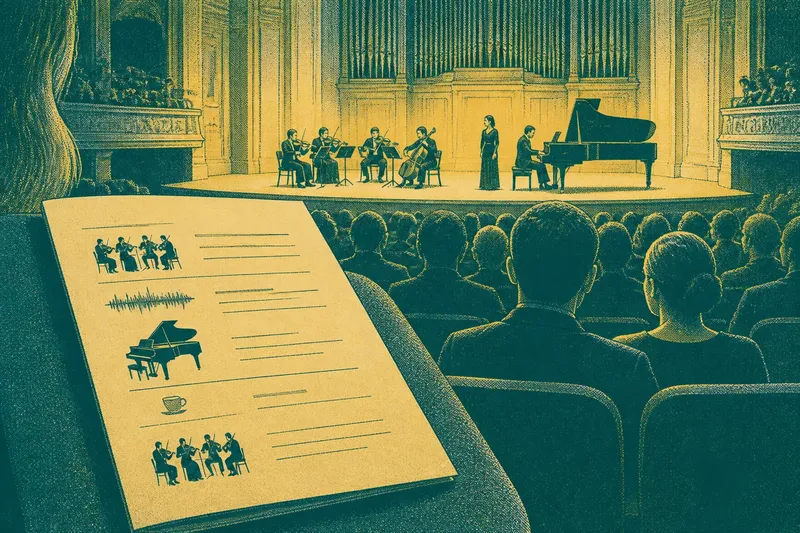
Before the Booklet: How Concertgoers Met the Music
Printed concert programme notes reveal how concertgoers encountered composers, performers, and works through the pages prepared for a particular event.
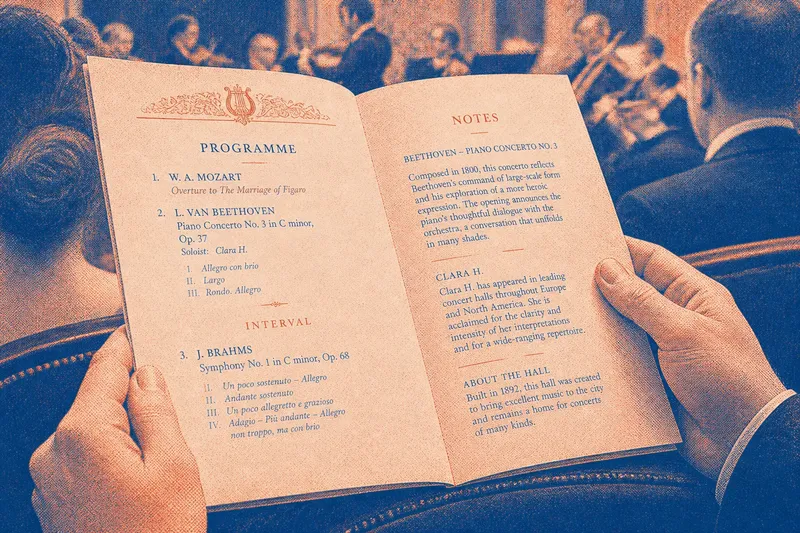
Printed concert programme notes put a concert’s names, order, and brief explanations in a listener’s hands, though what they offered varied by venue and period. The booklet was not a universal source of musical knowledge; it was one part of a particular evening’s printed record, shaped by what the organizers chose to include.
What booklets recorded
A concert programme commonly identified works and performers and set out the order of the event. Some included explanatory notes, biographies, or information about a composition’s background. Others were brief lists. The amount of text depended on the concert and its organizers, so there was no single historical booklet that represented every audience.
These pages could connect a name on the page with the people and music heard in the hall. A listener might refer to a composer’s name, check which work came next, or read a short account of a piece. That information framed the event without determining what each person heard in the performance.
Editorial choices
Programme writers selected which details to present. A note could foreground a work’s structure, its historical setting, or a composer’s biography; another might give little beyond a title and a few lines. Those choices reveal the concert’s approach to explanation as much as they supply background.
The format also affected what could be included. A short leaflet had limited room, while a more substantial booklet could accommodate longer essays and performer biographies. Print made those choices visible in a single object that a listener could read during the event or keep afterward.
From information to interpretation
Not every programme note simply identified what was being performed. Some offered an interpretation: an account of a work’s form, an image to keep in mind, or a story about its creation. Such writing invited a particular way of listening, but it could not settle the meaning of a performance for every listener.
This distinction matters when reading older notes. A programme is evidence of what its editors presented, not a complete record of how the audience responded. Its wording can show which facts or interpretations were made available at the concert, while leaving individual reactions unknown.
How did programme notes work?
What information appeared in a concert programme?
Programmes could list work titles, composers, performers, and the sequence of the concert. Some also included biographies or explanatory notes, while others remained concise lists.
Did every listener read the notes?
A printed note made information available, but it does not tell us whether each person read it. Some listeners may have consulted the booklet, while others may have focused on the performance or used it only to check the order.
Why did programme notes differ?
Organizers had different amounts of space and different editorial aims. A short recital leaflet and a larger orchestral booklet could therefore present different levels of detail without either representing all concert programmes.
What can an old programme tell us?
It can show which works were listed, who was credited, and what explanatory material the organizers chose to print. It cannot, by itself, establish how the music sounded or what every audience member thought.
Reading a surviving programme
A surviving booklet is most useful when read as a document of its event. Start with the printed date and venue, then distinguish the work list from the notes and biographies. If a passage makes a claim about a composition, treat it as the editor’s account rather than an unquestionable description.
- Check the date and venue; if both are printed, use them to identify the event, but if either is missing, avoid assigning the booklet to a specific concert without other evidence.
- Check whether the page lists works in order; if it does, read it as the advertised sequence, but if it does not, do not infer the order from page placement alone.
- Check the credits beside each work; if a composer is named, record that printed attribution, but if the credit is absent or unclear, leave the attribution unresolved.
- Check whether a passage is labeled as a note or essay; if it is, treat its explanation as editorial commentary, but if no such label appears, separate factual listings from interpretive prose cautiously.
- Check the author credit for a note; if a writer is named, attribute the interpretation to that person, but if no author is listed, describe it as programme text rather than assigning authorship.
- Check for a printer, publisher, or sponsoring organization; if one is identified, record it as a production credit, but if none appears, do not guess who prepared the booklet.
Say you find a leaflet naming a recital venue, a composer, and two works, followed by an unsigned paragraph describing the first piece as a dialogue between instruments. You record the venue and listed works as printed details, then describe the paragraph as an unsigned interpretation. The result is a useful account of what the leaflet says without turning its image into a claim about what every listener heard.
What the booklet leaves out
A programme is selective by design. It may omit rehearsal decisions, audience responses, or details about how a performance differed from the printed description. Even a detailed essay cannot stand in for the sound in the room or for listeners’ varied reactions.
That limitation does not make the booklet unimportant. It makes its role clearer: a printed programme preserves the information and framing offered for a specific event. Read alongside other records, it can help describe how a concert was presented, while leaving space for the performance and its audience to remain more than the page can capture.
For anyone tracing how concertgoers met unfamiliar music, printed concert programme notes are best treated as part of the encounter, not a complete account of it. The names, sequence, and commentary show what organizers placed before listeners; the unprinted response belongs to the people who were there.