Three Lines to Keep After a Concert
Three lines to keep after a concert preserve a sound, a moment of attention, and a question, turning a fading impression into a personal memory.
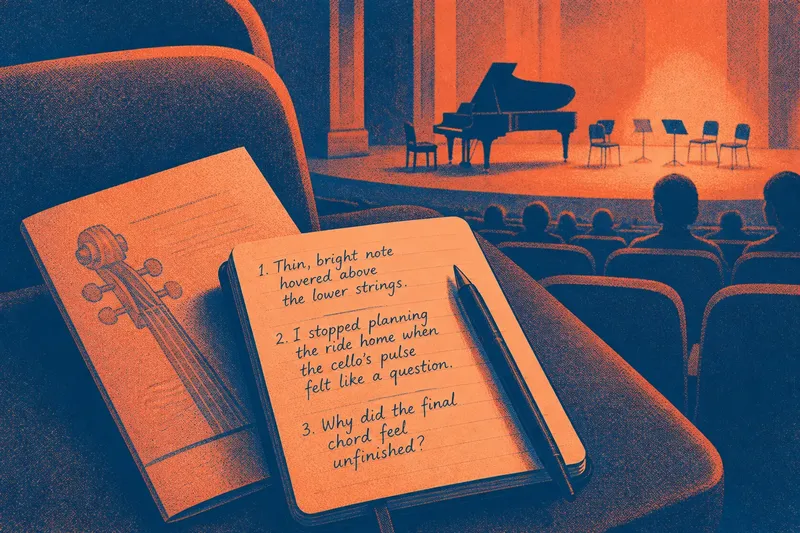
Three lines to keep after a concert can preserve what a printed program cannot: a sound you noticed, the moment your attention shifted, and a question you carried out of the hall. Write them soon after the performance, while a detail remains vivid but before you feel obliged to explain the whole evening. The aim is not a review or a record of every piece, but a small, personal trace of listening.
A small record
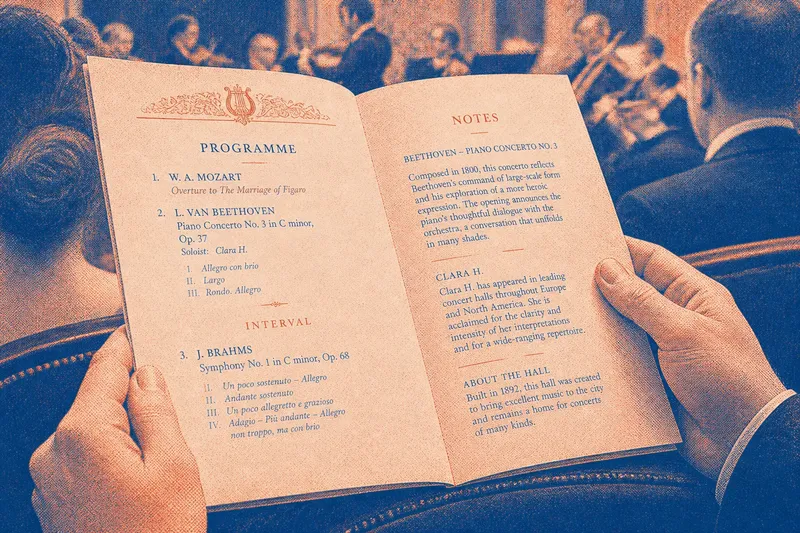
A concert program names composers, performers, and works. Your three lines record something different: an audible detail, a moment when you became especially attentive, and an open question. Together, they offer a compact way to remember how the music reached you, rather than only what was played.
Keep the lines separate. That modest structure helps when the evening feels difficult to summarize, and it gives each kind of memory room to be specific. A sound is something you noticed; a moment of attention describes your listening; a question points toward what remains unresolved.
Use a pocket notebook, the notes app on your phone, or the blank margin of a program. Choose a place you can reach without interrupting people around you. You do not need a special journal, a polished style, or a complete account.
One remembered sound
For the first line, name a sound you can still hear in your mind. It might be a low string tone, a breath before a singer’s entrance, a chord that seemed to hang in the room, or the sudden quiet after a final note. Describe the sound in ordinary language rather than reaching for technical terms you are unsure about.
Make the detail distinct enough to call the moment back. “The violin was beautiful” gives little to hold onto. “A thin, bright note hovered above the lower strings” describes a texture and a relationship between sounds. If you know the instrument or technique, name it; if not, an honest impression is more useful than a guessed label.
Try to include one audible quality, such as weight, brightness, softness, or roughness. You can also note how the sound changed: it swelled, broke off, blended, or seemed to recede. This is not a technical analysis. It is a way of making a fleeting impression easier to recognize later.
One moment of attention
The second line records when you noticed yourself listening differently. Perhaps a restless mind settled during a quiet passage, or you began following the bass after hearing it answer a melody. You might have become aware of the audience’s stillness, the performer’s breathing, or the contrast between a resonant hall and a dry, close sound.
Describe the shift without judging yourself. Concert attention naturally moves: a thought intrudes, a sound draws it back, or a familiar passage takes an unexpected turn. The useful memory is not that you listened perfectly, but what called your attention back or held it in place.
Say you attend a chamber concert and notice you have been thinking about the trip home. Then a repeated figure in the cello catches your ear, and you follow it through the next passage. Your second line could read, “I stopped planning the ride home when the cello’s repeated pulse began to feel like a question.” It records a change in your listening without claiming that the music has only one meaning.
One open question
The third line should leave room for uncertainty. Ask about a musical choice, a connection you sensed, or something you could not quite hear. “Why did the final chord feel unfinished?” returns you to a particular experience; “Was it good?” asks for a verdict.
A useful question does not have to be answered that night. You might wonder whether a recurring rhythm changed character, how a singer shaped a phrase, or why a quiet ending stayed with you. If the question calls for background, you can later consult the program, a recording, or a knowledgeable listener. It is also fine for the question to remain a record of curiosity rather than a problem to solve.
When should you write?
Should you write during the performance?
Usually, wait until the music has ended so you can keep your attention on the performers. If a detail feels likely to vanish, remember a single cue word rather than composing a sentence in the hall.
What if you cannot name the instrument?
Describe what you heard: a bright line above a low, steady sound, for example. A clear impression is more dependable than assigning an instrument or technique by guesswork.
Can the three lines be fragments?
Yes. A phrase such as “soft drums under the voice” can be enough to revive a sound later. The lines are private memory aids, not finished prose.
What if nothing stands out?
Choose the smallest detail you remember, even if it is a pause, a change in volume, or the way the room held silence. A question about why the evening felt hard to follow can also be an honest third line.
Keep the ritual light
Do not turn the three lines into a demand to account for every piece or prove that you understood the performance. A note can be partial, uncertain, and even contradictory: a sound may have seemed warm in the hall but distant in memory. That difference is part of recollection, not a flaw to edit away.
Say you leave a recital with a scrap of paper and remember only a crisp piano attack, the moment a repeated phrase made you lean forward, and the question of why the ending felt calmer than the music before it. Those observations give you a route back into the evening without recreating the entire program. If you later hear the work again, the note can help you notice what has changed in your listening.
Keep the lines with the program, or save them under the concert’s date and venue in your notes app. When you return to them, add a brief follow-up only if something new comes to mind; leave the original wording intact. Three lines to keep after a concert work best when they preserve the first impression alongside whatever you learn later, so the memory remains personal and open.